Nitesh Kumar
Founder, VaidikVivah · Vedic marriage consultant & full-stack engineer specialising in Jyotish-powered matchmaking.
What Manglik Dosha actually means, which houses create it, what severity levels exist, when it is cancelled — and why it is not the deal-breaker many families believe it to be.
What is Manglik Dosha?
Manglik Dosha (also called Mangal Dosha or Kuja Dosha) occurs when Mars is placed in the 1st, 4th, 7th, 8th, or 12th house of the birth chart counted from the Lagna (Ascendant). Some astrologers also check the same positions from the Moon Lagna and Venus Lagna — this stricter method makes more people appear "Manglik." Mars (Mangal) is a planet of energy, drive, and assertion. When it occupies houses associated with partnerships and household life, classical texts suggest it can bring friction or challenge in those areas — particularly in marriage.
How Common Is Manglik Dosha?
Manglik Dosha is far more common than many families realise. Depending on which method is used: • Lagna-only method: roughly 25–40% of birth charts have Manglik Dosha • Triple method (Lagna + Moon + Venus): up to 50–60% of people may qualify This prevalence is one reason astrologers emphasise severity and cancellation rather than treating Manglik Dosha as a binary yes/no condition. Half the population cannot be unsuitable for marriage.
Advertisement
Severity Levels
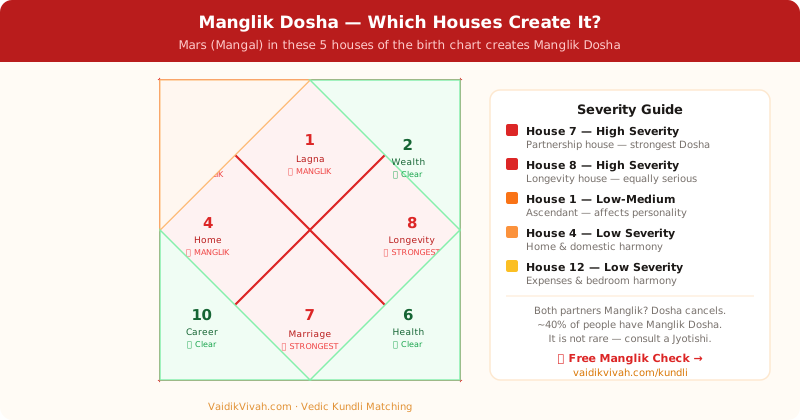
Not all Manglik Dosha is equal. Severity varies by which house Mars occupies: • 1st house (Low-Medium): Mars in the Ascendant — affects personality and self-expression in marriage • 4th house (Low): Affects domestic harmony and home environment • 7th house (High): Directly affects the house of partnership and marriage — considered most significant • 8th house (High): Affects longevity and shared resources — often considered most challenging • 12th house (Low): Affects expenses and bedroom harmony The 7th and 8th house positions are traditionally considered the strongest Manglik Dosha. 4th and 12th are milder.
When is Manglik Dosha Cancelled?
Several classical cancellation rules can reduce or eliminate Manglik Dosha: • Mars is in its own sign (Aries or Scorpio) — Dosha is reduced • Mars is in an exaltation sign (Capricorn) — strength of Dosha diminishes • Mars is aspected by Jupiter — Jupiter's benefic nature mitigates the effect • The 7th house is occupied or aspected by a strong benefic (Jupiter, Venus, Mercury) • Both partners are Manglik (same-Dosha pairing) • Mars is with or aspected by the Moon — according to some schools • The person is born on Tuesday — according to some regional traditions A qualified Jyotishi should assess which cancellation rules apply to your specific chart.
Does a Manglik Person Have to Marry Another Manglik?
This is one of the most common concerns families bring to astrologers. The answer is: not necessarily. The "same-Manglik pairing" guideline applies when the Dosha is strong (7th or 8th house Mars) and no cancellation rules apply. In such cases, matching severity levels is sometimes advised to "balance" the chart energy. However, if cancellation rules apply, or if the Dosha is mild (4th or 12th house), the strict same-Manglik requirement may not apply at all. A knowledgeable Jyotishi will assess the full chart — not just yes/no on Manglik — before making a recommendation. VaidikVivah's Kundli report shows severity level and applicable cancellation rules, giving families and their pandits the information they need for an informed conversation.
🔑 Key Takeaways
- ✦ Manglik Dosha occurs when Mars is in the 1st, 4th, 7th, 8th, or 12th house
- ✦ 7th and 8th house Mars are considered strongest; 4th and 12th are milder
- ✦ Up to 40–50% of people have some form of Manglik Dosha — it is not rare
- ✦ Multiple cancellation rules exist — a Jyotishi should evaluate which apply
- ✦ Same-Manglik pairing is sometimes advised for strong Dosha without cancellation, but not as a universal rule
🕉️ मुख्य बातें (हिंदी में)
- ✦ मंगलिक दोष तब होता है जब मंगल 1, 4, 7, 8 या 12वें भाव में हो।
- ✦ 7वें और 8वें भाव का मंगल सबसे प्रबल; 4था और 12वाँ मंद होता है।
- ✦ 40–50% लोग किसी न किसी रूप में मंगलिक होते हैं — यह दुर्लभ नहीं है।
- ✦ दोष-निवारण के कई नियम हैं — शास्त्रीय ज्योतिषी से परामर्श लें।
- ✦ केवल मंगलिक होने से रिश्ता अस्वीकार न करें; सम्पूर्ण कुंडली देखें।
Frequently Asked Questions
▸What exactly is Manglik Dosha?
Manglik Dosha (also called Mangal Dosha or Kuja Dosha) occurs when Mars is placed in the 1st, 4th, 7th, 8th, or 12th house of the birth chart counted from the Lagna. Mars is the planet of energy and assertion; when it occupies houses linked to partnerships and home life, classical Vedic texts suggest it can introduce friction in marriage.
▸How common is Manglik Dosha?
Far more common than most families assume. Using the Lagna-only method, roughly 25–40% of birth charts qualify as Manglik. Using the stricter triple method (Lagna + Moon + Venus), the figure rises to 50–60%. This is one reason astrologers stress severity and cancellation rules rather than treating it as a binary verdict.
▸Which Manglik Dosha positions are most serious?
Mars in the 7th house (the partnership house) and the 8th house (longevity and shared resources) are traditionally considered the strongest Manglik Dosha. Mars in the 4th and 12th houses is milder. Mars in the 1st house is low-to-medium severity. A qualified Jyotishi will weigh the house, sign, aspects, and overall chart quality together.
▸Can Manglik Dosha be cancelled?
Yes — several classical cancellation rules apply: Mars in its own sign (Aries or Scorpio) or exaltation sign (Capricorn); aspect by Jupiter; a strong benefic in the 7th house; same-Manglik pairing; Mars with the Moon; or birth on a Tuesday by some regional traditions. When cancellation applies, the Dosha is effectively neutralised.
▸Does a Manglik person have to marry another Manglik?
Not necessarily. The same-Manglik pairing guideline is traditionally suggested only when the Dosha is strong (7th or 8th house Mars) and no cancellation rules apply. If cancellation rules apply, or the Dosha is mild (4th or 12th house), strict same-Manglik matching is not required. A full chart analysis is always better than yes/no Manglik filtering.
▸How can I check if I am Manglik?
You need your exact date, time, and place of birth. VaidikVivah’s free Kundli tool computes Manglik status from Lagna, Moon Lagna, and Venus Lagna, shows severity by house, and lists which classical cancellation rules apply to your chart. The report is formatted to share with your family pandit for a final review.
🕉 This article is educational in nature. Vedic astrology is a traditional knowledge system — always consult a qualified Jyotishi for personalised guidance on your specific charts and circumstances.