Nitesh Kumar
Founder, VaidikVivah · Vedic marriage consultant & full-stack engineer specialising in Jyotish-powered matchmaking.
A plain-language guide to Guna Milan (Ashtakuta matching) — what all 8 Kootas measure, how scoring works, what counts as a good match, and when Dosha cancellation applies.
What is Guna Milan?
Guna Milan (also called Ashtakuta Milan) is the most widely used compatibility system in Hindu marriage matching. It evaluates two birth charts across eight different dimensions — called Kootas — and assigns a score between 0 and 36. The higher the score, the more compatible the pairing is considered in Vedic tradition. The word "Ashtakuta" literally means "eight tests." Each Koota checks a specific aspect of the couple's compatibility — from basic social harmony to physical temperament to physiological constitution.
The 8 Kootas Explained
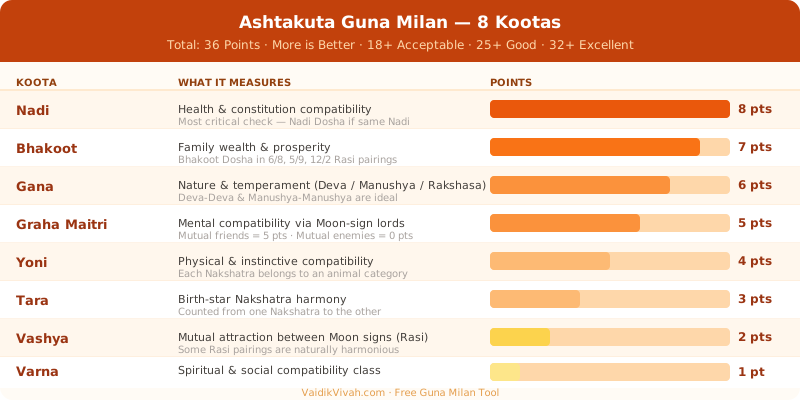
1. Varna (1 point): Checks social and spiritual compatibility. Each Nakshatra belongs to one of four varnas — Brahmin, Kshatriya, Vaishya, or Shudra — in this system (not caste in the social sense). Typically, the man's Varna should be equal to or higher than the woman's. 2. Vashya (2 points): Checks mutual attraction and influence between the two Rasis (Moon signs). Some Rasi pairings are naturally dominant-submissive, some are neutral, and some are mutually attractive. 3. Tara (3 points): Checks birth star compatibility by counting from one Nakshatra to the other. Specific numbered positions (1st, 3rd, 5th, 7th) are unfavourable; others are auspicious. 4. Yoni (4 points): Checks physical and temperamental compatibility. Each Nakshatra belongs to an animal category (horse, elephant, snake, etc.) — the compatibility of the two animals determines the score. 5. Graha Maitri (5 points): Checks mental compatibility via the friendship or enmity between the lords of both Moon signs. Mutual friends score 5; mutual enemies score 0. 6. Gana (6 points): Checks nature compatibility. People belong to one of three Ganas — Deva (divine), Manushya (human), or Rakshasa (fierce). Deva-Deva and Manushya-Manushya are best; Rakshasa-Deva pairings may have friction. 7. Bhakoot (7 points): Checks Rasi-based compatibility — whether the Moon signs form a harmonious or conflicting relationship. The 6/8, 5/9, and 12/2 pairings form Bhakoot Dosha (0 points), while other pairings score 7. 8. Nadi (8 points): The highest-weighted check. Each Nakshatra belongs to one of three Nadis — Adi, Madhya, or Antya. If both partners have the same Nadi, Nadi Dosha applies (0 points). Different Nadi = 8 points.
Advertisement
How to Interpret Your Score
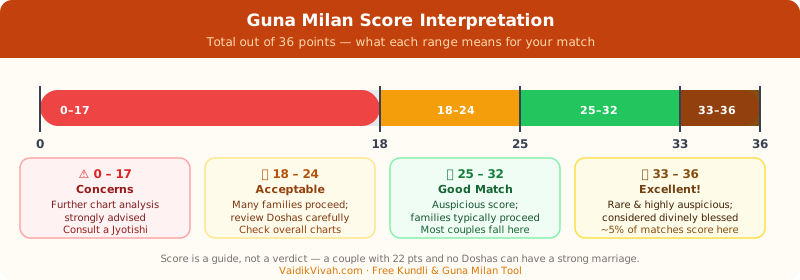
Once all 8 Kootas are scored, they add up to a number between 0 and 36. • 0–17 points: Compatibility concerns — most families seek additional chart analysis or consider other matches • 18–24 points: Acceptable — many families proceed with careful review of any Doshas present • 25–32 points: Good — considered auspicious for marriage • 33–36 points: Excellent — rare and considered highly auspicious Important: The total score is a guide, not a verdict. A couple scoring 22 with good overall chart quality and no serious Doshas can have a strong marriage. A couple scoring 30 with severe Nadi Dosha and incompatible charts still needs careful evaluation.
What About Dosha Cancellation?
Both Nadi Dosha (the most serious) and Bhakoot Dosha (second most serious) have established cancellation rules in classical Jyotisha: Nadi Dosha Cancellation: • Both partners have the same Nakshatra (same star, different Pada) • Both partners have the same Rasi (Moon sign) • The Nakshatra lords of both partners are the same Bhakoot Dosha Cancellation: • The lords of both Rasis are the same planet (e.g., both ruled by Venus) • The Rasi lords are mutual friends • Both partners share the same Rasi When cancellation applies, the Dosha is effectively neutralised and the pairing can proceed normally. A qualified Jyotishi should confirm which rules apply to your specific combination.
Guna Milan vs. South Indian Porutham
North and Central Indian families typically use the 8-Koota Ashtakuta system described above. South Indian families — Tamil, Telugu, Kannada — use a different system: • Tamil families use 10-point Nakshatra Porutham (Dasa Porutham) • Key checks include Rajju (longevity) and Vedhai (conflict) Poruthams • Rajju Porutham is considered the most critical in Tamil tradition VaidikVivah's Kundli tool supports both systems — showing Ashtakuta scores for all users and the 10-point Tamil Porutham for Tamil profiles.
🔑 Key Takeaways
- ✦ Guna Milan checks 8 aspects of compatibility, scoring 0–36 total
- ✦ Nadi (8 pts) and Bhakoot (7 pts) are highest-weighted — and both have cancellation rules
- ✦ Scores of 25+ are generally good; 18–24 are acceptable
- ✦ The score is a framework for discussion — overall chart quality matters just as much
- ✦ South Indian families use a different 10-point Porutham system
🕉️ मुख्य बातें (हिंदी में)
- ✦ गुण मिलान (अष्टकूट) हिंदू विवाह में अनुकूलता जाँचने की सबसे प्रचलित विधि है।
- ✦ 8 कूटों पर कुल 36 अंक दिए जाते हैं — 25+ उत्तम, 18–24 स्वीकार्य।
- ✦ नाड़ी कूट (8 अंक) और भकूट (7 अंक) सबसे महत्वपूर्ण हैं।
- ✦ नाड़ी दोष और भकूट दोष दोनों में दोष-निवारण के शास्त्रीय नियम हैं।
- ✦ केवल गुण मिलान स्कोर पर नहीं — सम्पूर्ण कुंडली की गुणवत्ता भी देखें।
🕉 This article is educational in nature. Vedic astrology is a traditional knowledge system — always consult a qualified Jyotishi for personalised guidance on your specific charts and circumstances.