Nitesh Kumar
Founder, VaidikVivah · Vedic marriage consultant & full-stack engineer specialising in Jyotish-powered matchmaking.
What Gotra is, why same-Gotra marriage is avoided, how the Chaar-Gotra and Sapinda traditions work, and how VaidikVivah uses Gotra data to help families match safely.
What is Gotra?
Gotra is a patrilineal lineage marker in Hindu tradition — it traces descent through the male line back to an ancient Rishi (sage) who is considered the founding ancestor of that lineage. The word "Gotra" comes from Sanskrit and literally means "cow shed" — in ancient times, families of the same lineage shared a common dwelling. In modern usage, Gotra is a name — like Kashyap, Bhardwaj, Atri, Vasishtha, Vishwamitra, Jamadagni, Gautam, or Agastya — that identifies which ancient sage's lineage a person belongs to through their father's male line.
Why is Same-Gotra Marriage Avoided?
In Hindu tradition, people of the same Gotra are considered to be of the same lineage — essentially siblings in ancestry. Marriage within the same Gotra is therefore considered incestuous in the traditional framework and is avoided in most Hindu communities. This rule is followed across Brahmin, Rajput, Jat, Kayastha, Agarwal, and many other communities — though the strictness varies. Some communities avoid same-Gotra on the groom's side only; others follow the Chaar-Gotra tradition which extends this exclusion to four Gotras.
Advertisement
The Chaar-Gotra Tradition
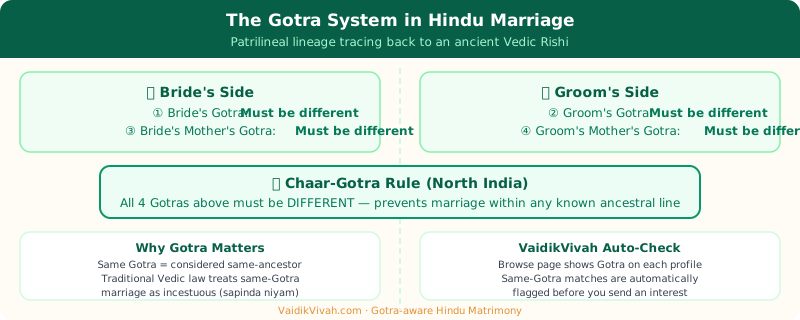
The Chaar-Gotra (four-Gotra) tradition is most commonly followed in North Indian communities, particularly Punjabi, Jat, and Rajput families. Under this tradition, four Gotras must be different: 1. The groom's Gotra (his father's Gotra) 2. The bride's Gotra (her father's Gotra) 3. The groom's mother's Gotra (her natal Gotra, before marriage) 4. The bride's mother's Gotra (her natal Gotra, before marriage) Avoidance of these four Gotras is meant to prevent marriage within any known ancestral line from either parent's side.
Pravara — The Extended Gotra Check
Beyond Gotra, some Brahmin families also check Pravara — the list of distinguished ancestors within a Gotra lineage. Each Gotra has 1, 3, or 5 Pravaras (usually 3 in practice). If two people have the same Gotra but are far apart in the lineage, checking Pravara can help clarify whether the Sapinda (close kinship) restriction applies. In practice, most families simply check that the Gotra differs — Pravara comparison is typically done by a family pandit for higher-scrutiny matches.
How VaidikVivah Uses Gotra Data
VaidikVivah collects Gotra (and where available, Pravara and Kul) as a standard field on all profiles. When you browse profiles, the platform automatically flags profiles that share your Gotra — visible before you send an interest. This gives families the information they need upfront without awkward conversations after. For communities following the Chaar-Gotra tradition (Punjabi, Jat, Rajput families), we recommend noting all four relevant Gotras and checking them manually on the Browse page. Future versions of the platform will automate this check. Gotra fields are visible on profiles and included in the profile PDF report, making it easy to share with a family pandit for further review.
🔑 Key Takeaways
- ✦ Gotra is a patrilineal lineage marker tracing back to an ancient Rishi ancestor
- ✦ Same-Gotra marriage is avoided because those of the same Gotra are considered ancestral siblings
- ✦ The Chaar-Gotra tradition extends this to four Gotras — from both sides of both families
- ✦ Pravara is an extended lineage check within Gotra, typically verified by a pandit
- ✦ VaidikVivah shows Gotra on profiles and flags same-Gotra matches automatically
🕉️ मुख्य बातें (हिंदी में)
- ✦ गोत्र पितृ-पक्षीय वंश-परम्परा का नाम है जो एक प्राचीन ऋषि से जुड़ा है।
- ✦ एक ही गोत्र में विवाह वर्जित है — पैतृक भाई-बहन का रिश्ता माना जाता है।
- ✦ चार-गोत्र परम्परा में वर-वधू दोनों पक्षों के चारों गोत्र अलग होने चाहिए।
- ✦ प्रवर — गोत्र के भीतर की वंशावली — उच्च-स्तरीय मिलान में पंडित जी जाँचते हैं।
- ✦ वैदिक विवाह पर समान गोत्र स्वतः फ्लैग होता है।
🕉 This article is educational in nature. Vedic astrology is a traditional knowledge system — always consult a qualified Jyotishi for personalised guidance on your specific charts and circumstances.