Nitesh Kumar
Founder, VaidikVivah · Vedic marriage consultant & full-stack engineer specialising in Jyotish-powered matchmaking.
A practical guide for families on what to look at in a Kundli before marriage — the 7th house, Navamsa chart, Dasha period, Guna score, Manglik status, and what questions to ask the pandit.
Why Families Review Kundlis Before Marriage
A Kundli (birth chart or horoscope) is a map of the sky at the moment of birth. In Vedic astrology, it is believed to indicate personality tendencies, life patterns, and the timing of major life events — including marriage. Families review Kundlis before marriage not to predict the future with certainty, but to understand potential compatibility factors, identify any concerns that need discussion, and choose an auspicious timing for the wedding. Think of it as one input into a larger decision — not the only factor.
The 7th House — The Marriage House
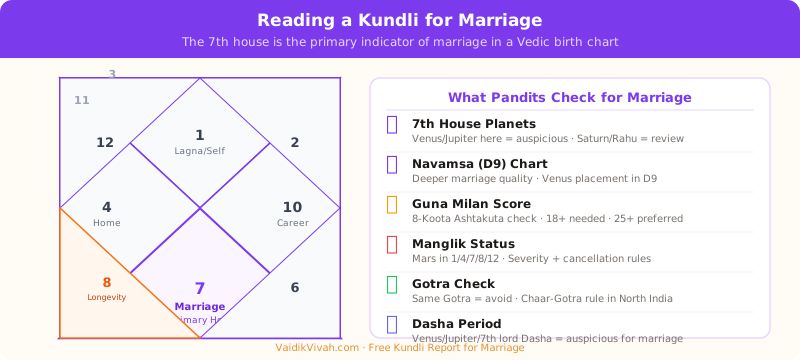
The 7th house in the birth chart is the primary indicator of marriage and partnerships. When reviewing a Kundli for marriage, the pandit will typically look at: • Which planet(s) occupy the 7th house — Venus and Jupiter here are generally auspicious; Saturn and Rahu may bring delays or challenges • The lord of the 7th house — its sign, strength, and aspects • Whether the 7th house lord is in a friendly or enemy sign • Aspects on the 7th house from other planets — Jupiter's aspect is considered very auspicious The 7th house being well-placed is a positive indicator for a stable, harmonious marriage.
Advertisement
The Navamsa (D9) Chart — Deeper Marriage Insight
Experienced Jyotishis always look at the Navamsa (D9) chart alongside the main birth chart (D1) for marriage assessment. The Navamsa divides each sign into 9 equal parts, giving a finer picture of planetary strength and marriage tendencies. Key things to check in the Navamsa: • The 7th house of the Navamsa — its lord and occupants • Venus placement — Venus in the Navamsa indicates the quality of marital happiness • Whether strong planets in D1 remain strong in D9 (Vargottama = doubly strong) • The Navamsa Lagna and its lord A Kundli where the D1 and D9 both support the 7th house is considered very auspicious for marriage.
The Dasha Period — Timing of Marriage
Vedic astrology uses a Dasha (planetary period) system to time life events. The Vimshottari Dasha system divides a person's life into major periods of different planets. Marriage is most commonly seen during the Dasha or Antardasha (sub-period) of: • Venus (Shukra) — the natural karaka (significator) of marriage • Jupiter (Guru) — for women, Jupiter is the significator of husband • The 7th house lord • The Lagna lord (when favourably placed) If a person is not in any of these Dashas during typical marriage age, the pandit may look at the next favourable period. This is also why some people marry later — their auspicious Dasha simply arrives later.
Guna Score, Manglik, and Gotra — The Three Big Checks
Beyond individual chart analysis, three standard checks happen when two Kundlis are compared: 1. Guna Milan: The 8-Koota Ashtakuta scoring system (0–36 points). A score of 18+ is generally needed; 25+ is good. 2. Manglik Dosha: Check both charts for Manglik Dosha — severity and cancellation rules are assessed. Same-Manglik pairing may be advised for strong unmitigated Dosha. 3. Gotra: Not a Kundli check, but always done alongside — same-Gotra marriage is avoided in most Hindu communities as it means the couple share the same Rishi ancestor lineage. VaidikVivah's Kundli report covers all three — Guna score, Manglik status, and Gotra flagging — in one report, formatted to be shared with your family's pandit.
🔑 Key Takeaways
- ✦ 7th house and its lord are the primary marriage indicators in a Kundli
- ✦ Navamsa (D9) chart gives deeper marriage insight alongside D1
- ✦ Dasha period determines timing — Venus, Jupiter, and 7th lord Dashas favour marriage
- ✦ Guna score, Manglik status, and Gotra are the three standard checks when matching two charts
- ✦ A Kundli review is one input into the decision — not the only one
🕉️ मुख्य बातें (हिंदी में)
- ✦ कुंडली में सातवाँ भाव विवाह का मुख्य कारक है।
- ✦ नवमांश (D9) चार्ट विवाह की गहरी जानकारी देता है — D1 के साथ अवश्य देखें।
- ✦ शुक्र, गुरु और सप्तमेश की दशा में विवाह की सर्वाधिक सम्भावना होती है।
- ✦ गुण मिलान, मंगलिक स्थिति और गोत्र — ये तीन मुख्य जाँच हैं।
- ✦ कुंडली निर्णय लेने का एक आधार है, सब कुछ नहीं।
🕉 This article is educational in nature. Vedic astrology is a traditional knowledge system — always consult a qualified Jyotishi for personalised guidance on your specific charts and circumstances.